|


 




















 
Other pages on this site:

Collapsing World: a blog

Conley Cameras


a history in postcards
Vintage ocean liner postcards

My non-typewriter photography
Genealogy, with a focus on the Seaver, Bilyeu, Amidon, and Lowell branches
This site is copyrighted. Please don't use any of the materials here without my permission.
|


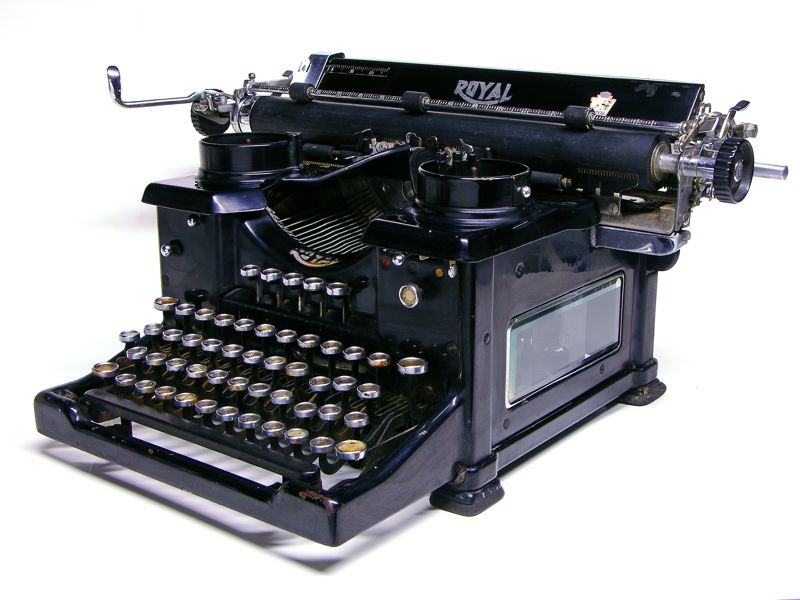
Royal was one of the longest-lived typewriter manufacturers. They introduced their first typewriter, the Royal #1, in 1906 and did not stop manufacturing tyepwriters until the 1970s. The company still exists, albeit having undergone many incarnations as part of various parent companies. Today, Royal is owned by Olivetti and still sells typewriters, though none with the famous Royal brand.
|
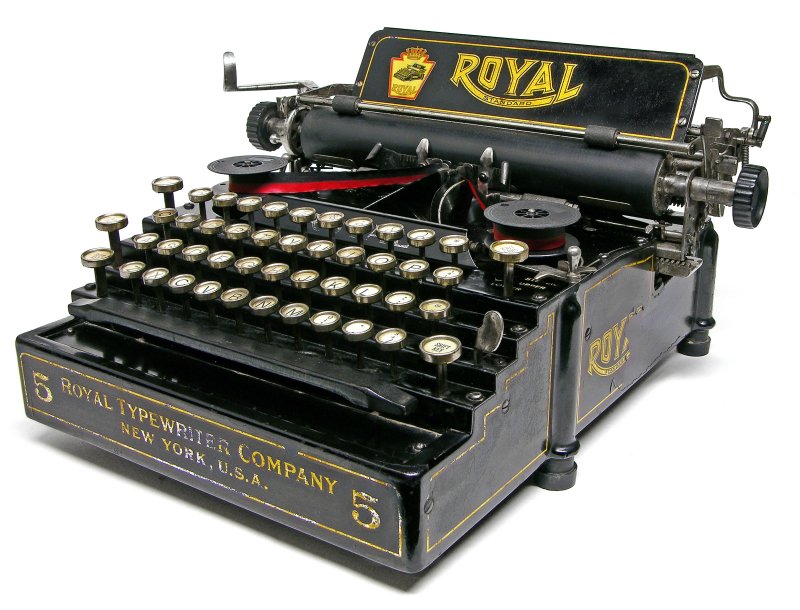
Royal Standard No.5
Serial # 165885-5
1913
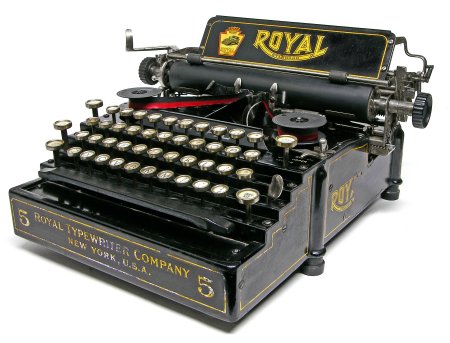
This early Royal design is commonly known as the "flatbed".
Download the manual for the Model 1 version of this typewriter here. |
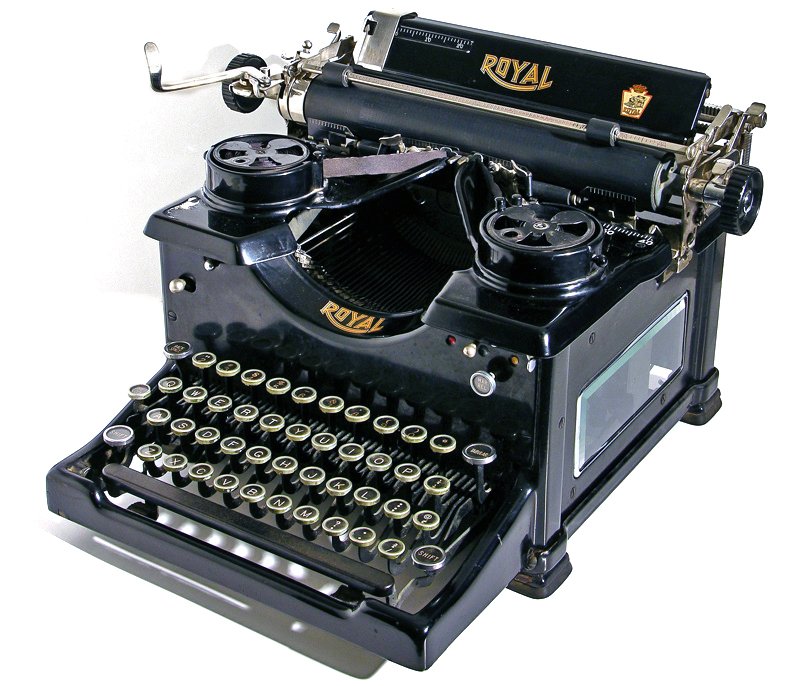
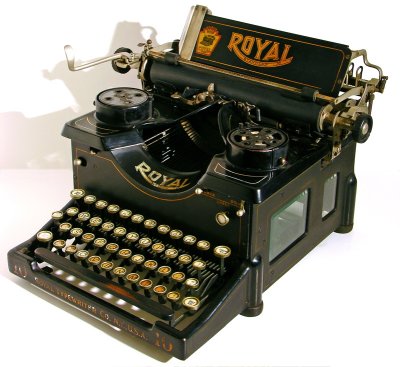
Royal
#10
Serial # X277685
1916
|
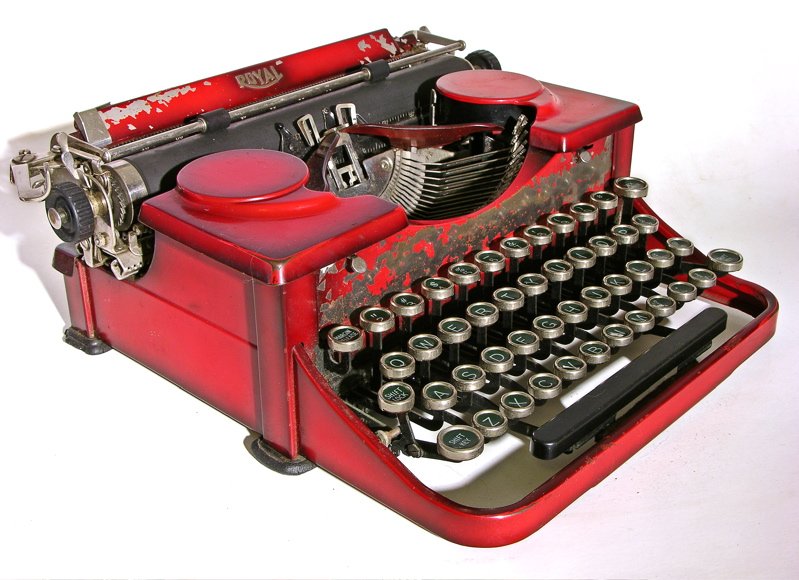
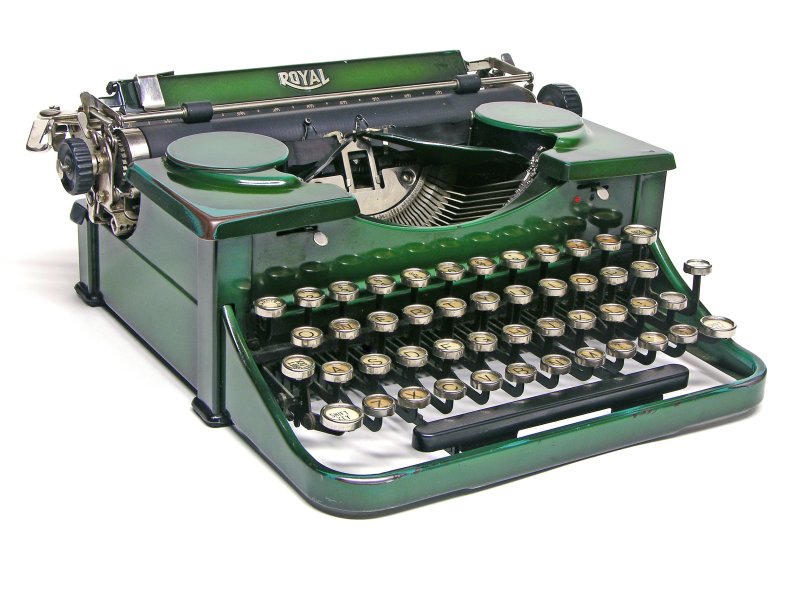
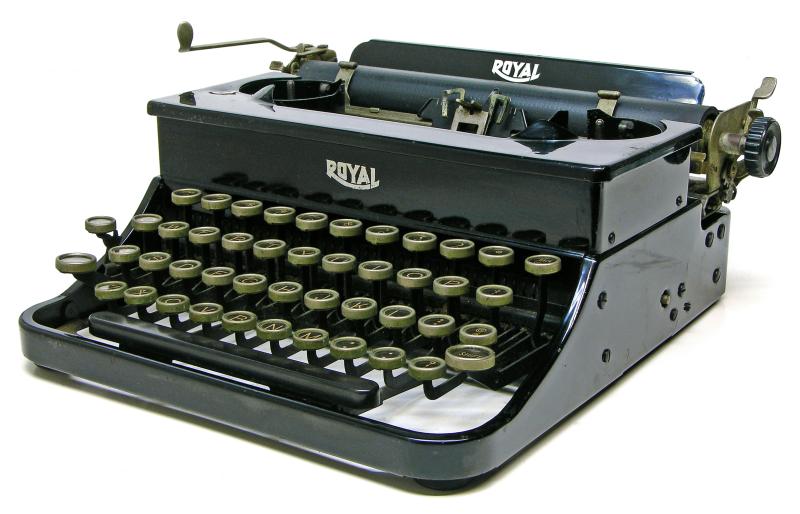
Royal Portable (2nd model)
Serial # P208665 & P249446
1930
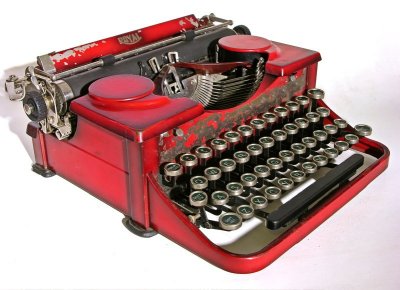
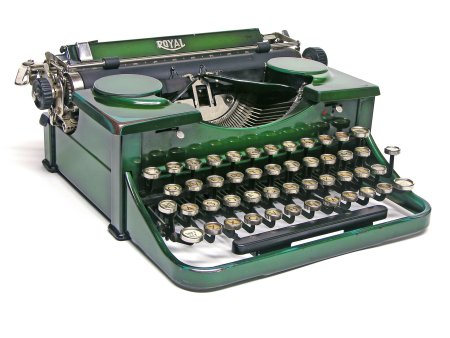
Note that although both the red and green versions of this model were manufactured in the same year, the red one has black-background keys and no tabulator, and the green one has white-background keys and a tabulator. |
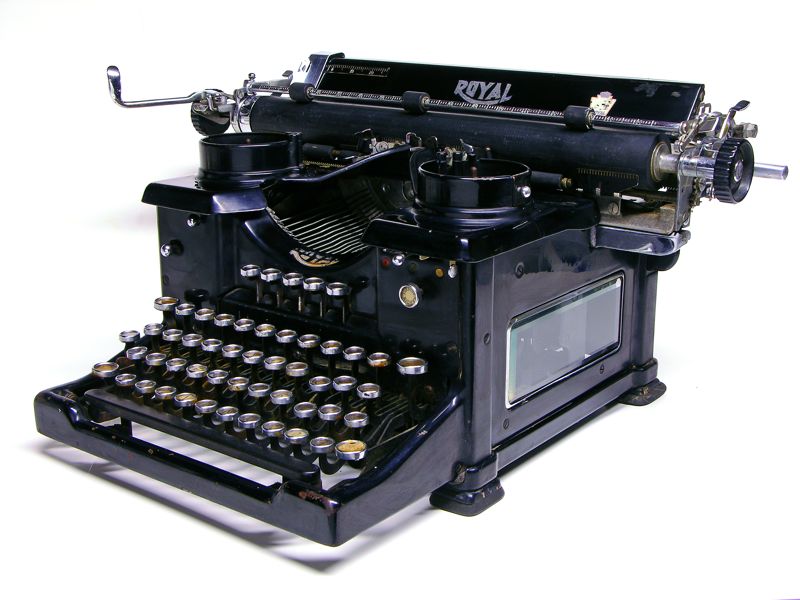
Royal
#10 (14" carriage)
Serial # 14-1582337
1932 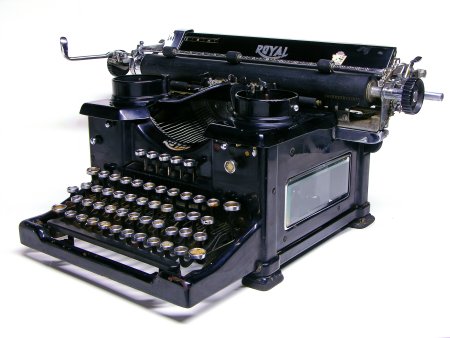
|
Royal Signet & Junior
Serial #s E5903, ES19889, J28077, J30689, BJ63590
1932-1935
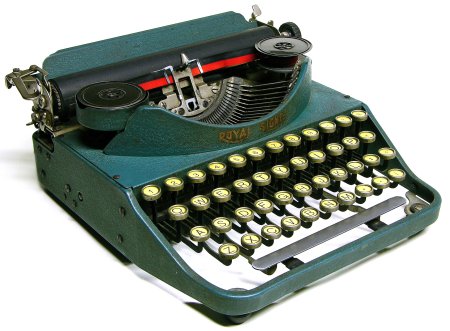
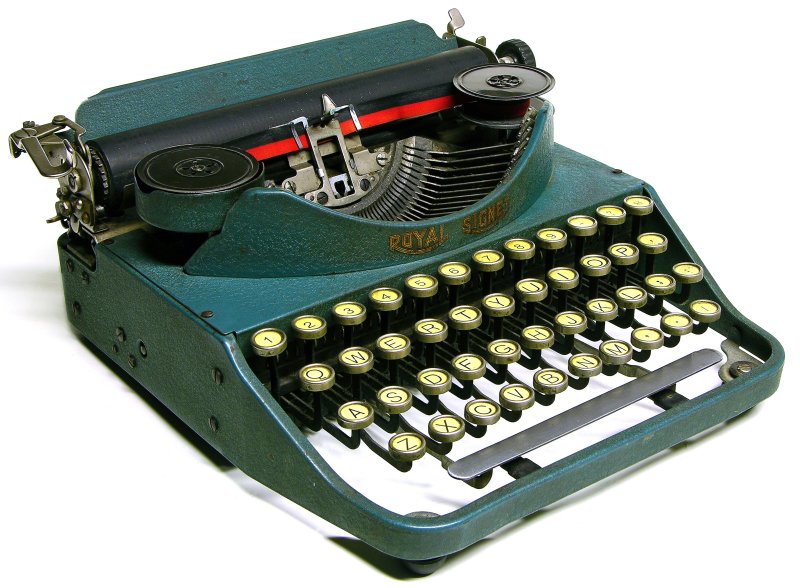
Little information is available on this family. The first of these, the Signet, was made only from Autumn, 1932 until about Sept, 1933. Rolled out with a heavy advertising campaign that included an essay contest, it was marketed as a low-cost alternative
for "children, housewives, and letter writers". It is caps-only, with a san-serif italic font designed especially for this machine for maximum readability. It's entirely possible that the Signet was Royal's answer to Remington's no-frills Remie Scout.
Despite immediate popularity, the Signet was abruptly discontinued after a single year. It seems that its low cost and popularity turned out to be its own undoing. The public was buying, but dealers weren't re-ordering. At $29.50, the Signet undercut the dealers' rental and rebuilt-machines business, both critical profit items. Royal had reasoned that the Signet's customers, once having mastered the Signet's simple features, would trade up for a more expensive model. However, in the thick of the Depression, dealers had little interest in waiting for the Signet to turn a profit "in the long run". So the Signet was discontinued and replaced around November, 1933, with something Royal internally called the 845, or "45" for short. (I'm still trying to identify exactly what this machine was.)
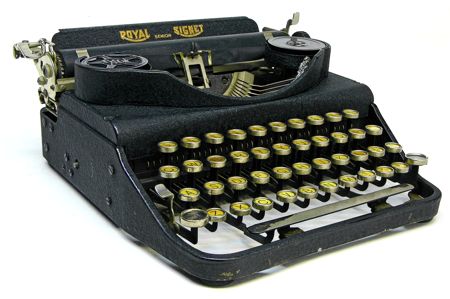
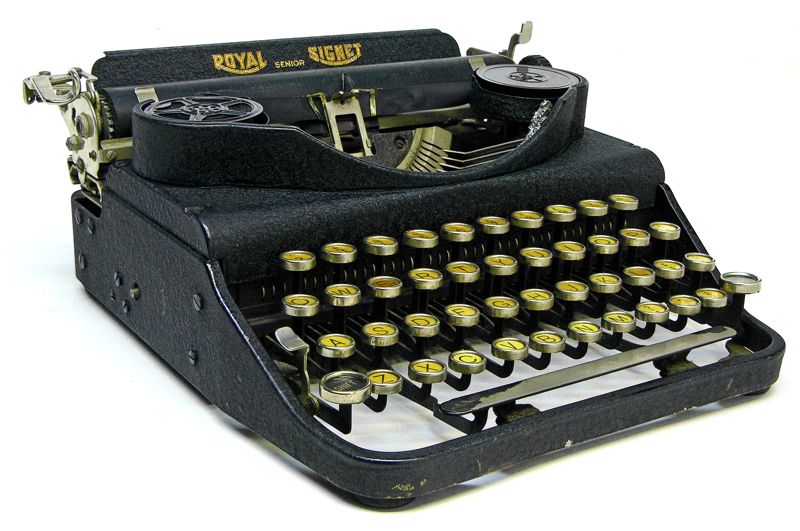
A variation, the Signet Senior, typed in standard upper- and lower-case, and came in black. It was apparently manufactured simultaneously with the caps-only Signet, leaving it unclear as to whether the two have unique serial number sequences or are intermixed. There are a few variations among Seniors: early ones have a tall "cowell" with the name printed up front, like the caps-only Signet; others, like the one shown here, have a shorter cowell and the name printed on the paper tray. Early Seniors have a single shift key, on the left, and a metal tab for a shiftlock. Later, a second shift key was added to the right side, and eventually the shiftlock was upgraded from a tab to a proper key.
The Signet is certainly radically different from all other Royal typewriters, except for its direct descendents shown below. It's so different that some people suspect that it was not designed by Royal at all. Lending substance to this theory is the fact that no Royal design patent exists for the Signet. I have found design patents for every other model, including the Junior and one model that was never made, but not for the Signet. There is one patent for an early concept of Royal's first portable: no. 1,417,910 from May, 1922. It bears a striking resemblance to the Signet. Perhaps an old design was dusted off and tweaked?
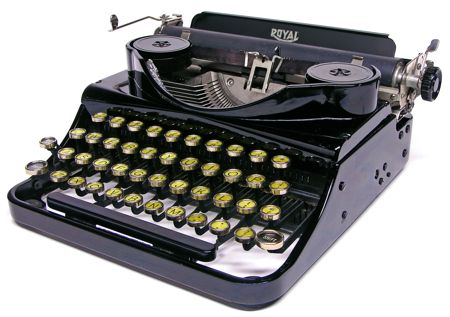
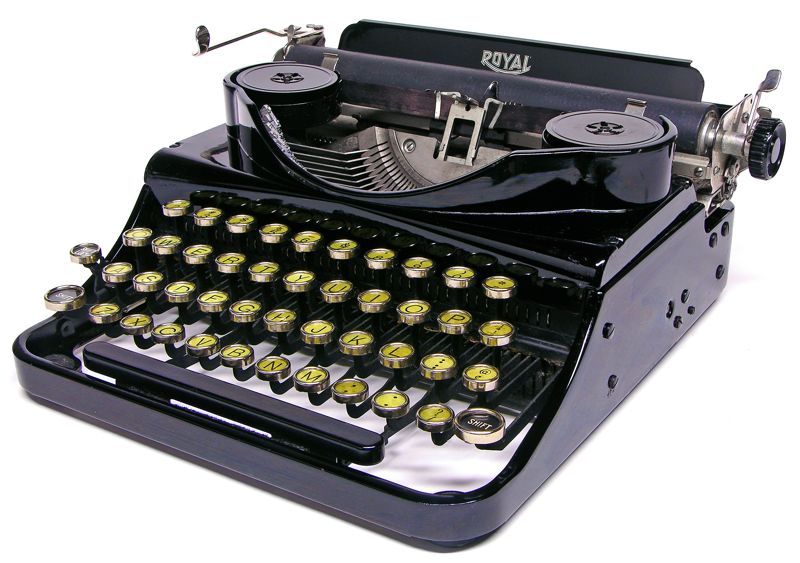
Following in the Signet's footsteps, the Junior was also aimed at Depression-stricken Americans. Like the Signet, there is no tab, backspace, margin release, ribbon color selector, or left-hand platen knob. Mounted in the center rear is a single left margin stop, eliminating the need for a right-margin bell. The shell is made of the thinnest sheet metal, easily pliable with your bare hands.
All evidence indicates that the Junior was a direct evolution of the Signet Senior, as their internal workings are virtually identical. The "missing link" model shown above is effectively a Signet Senior with the Junior name on it. It appeared sometime in late 1933 or early 1934 (the earliest ad I have seen ran in April, '34); only about 5,000 Juniors were made in this style before changing to the sloped-top body shown below.
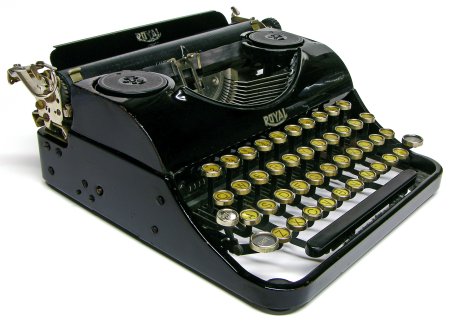
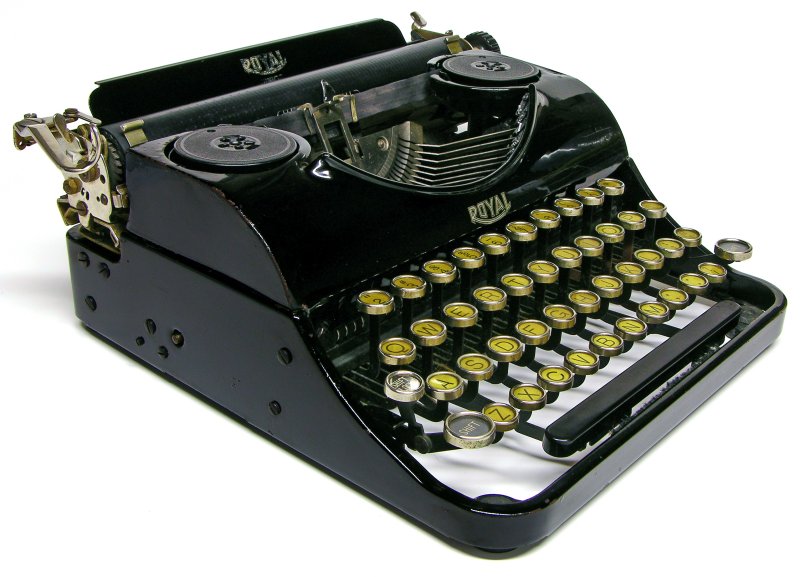
Yet another version of the Junior exists, with a squared-off shell more closely resembling other Royal products. It appears to have been introduced around June, 1935. Some are equipped with a backspace key, while others are not.
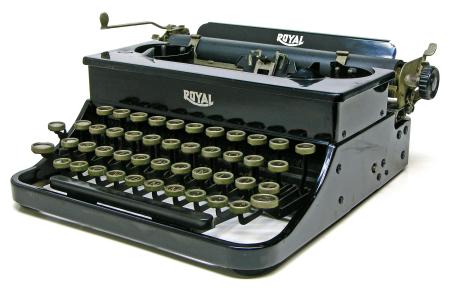
Based on ads, industry publications, and serial numbers, the timeline of the various versions is roughly:
1932: Signet (possibly shares serial number sequence with Signet Senior; at least 24,000 combined units)
1933: Signet Senior (>=24,000 combined w/original Signet); Signet bodied Junior (appx 5,000 made, 3,000 with crinkle finish, 2,000 with gloss finish)
1934: Sloped-body Junior (appx 30,000 made)
1935: squared Junior (unknown number made)
|
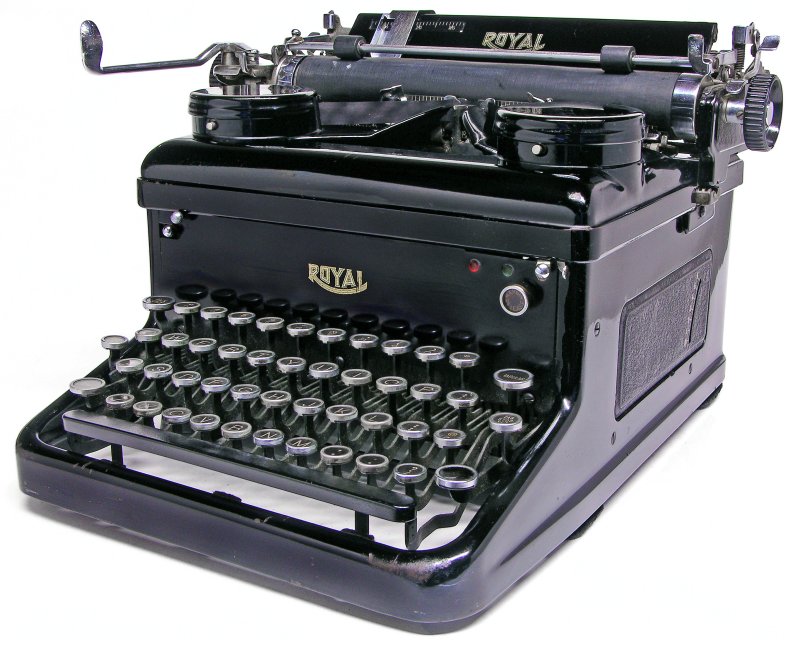
Royal
#10
Serial # S-1635451
1933
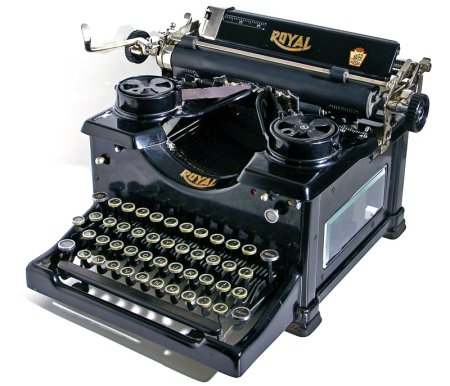
|
Royal Portable Standard
aka "Model O"
Serial # O-605667
1936
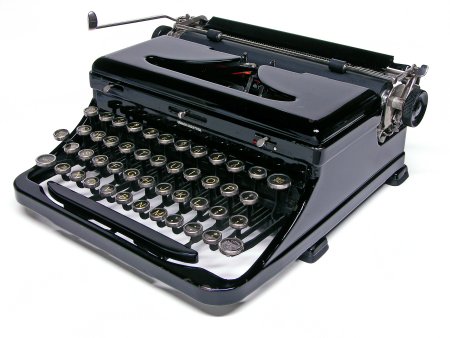
This model is frequently referred to as "Touch Control" because that is the only labeling to be found aside from the Royal logo (the decals, alas, are almost completely worn off of mine). Many collectors refer to it as the Model O because the serial number carries an "O" prefix. Officially, Royal called this the Portable Standard. It's unclear exactly when this body style was introduced; the earliest example I have seen dates to 1934. Later versions have a raised, wear-resistant logo on the paper rest.
The Standard/Touch Control/Model O is one of the most frequently found pre-war portables, and its commonality causes many collectors pass it over. Yet this is classic 1930s design, and a terrific typer for actual use. |
Royal DeLuxe
Serial # A569018
1936
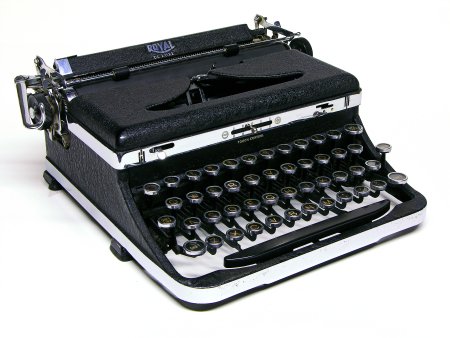
The DeLuxe is very similar to the Portable Standard in style and function. It has the addition of a tabulator, a paper guide, and of course its signature "crinkle" finish and chromed bands. Down the road, the DeLuxe would be merged with the short-lived Quiet model and become one of Royal's most popular models, the Quiet DeLuxe.
|
Royal KHM
Serial # KHM-2040988
1937
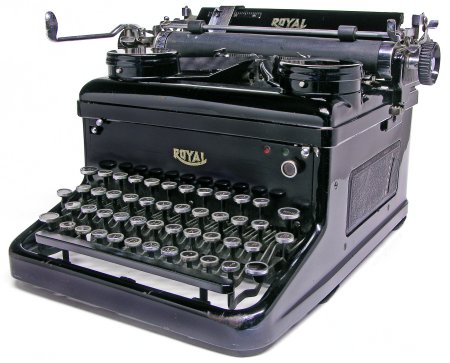
The KHM is essentially an update to the Model 10, with plastic inserts replacing the 10's iconic glass windows. Note the curved scale incorporated into the right-side panel. It's the indicator for a touch-control adjustment wheel located at the lower center of the back of the machine. Not a new innovation for Royal, but more visible than it had been.
|
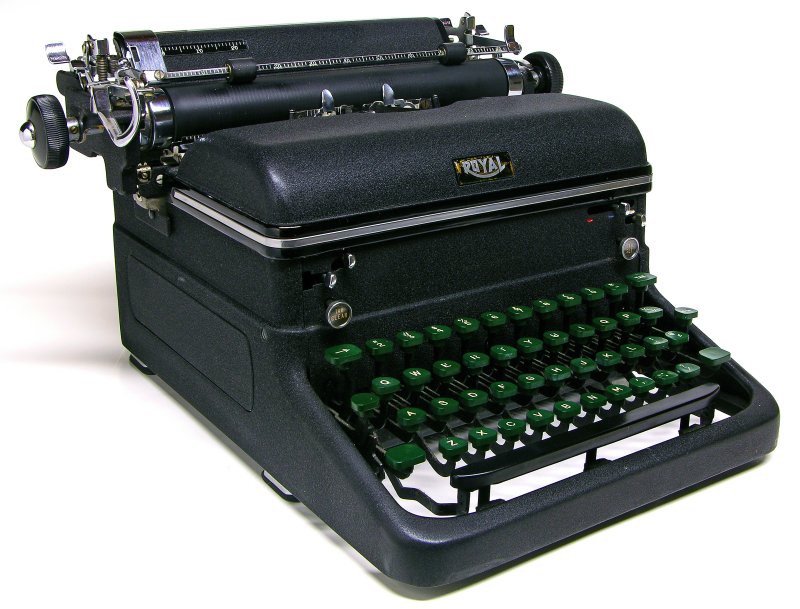
Royal
KMM
Serial # KMM-2627222
1939
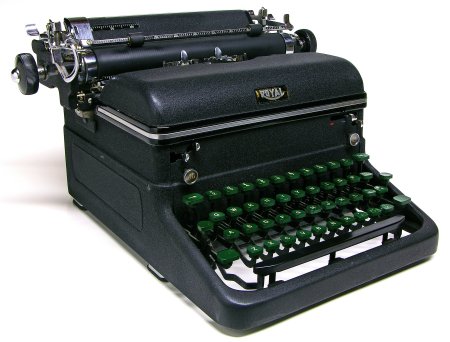
The KMM introduced Royal's famous and patented Magic Margin system, whereby holding down the right or left margin lever and sliding the carriage to the desired location "magically" set the margin. Although dating from 1939, this KMM was probably rebuilt sometime in the 1950s. The original round, glass-topped keys have been replaced with plastic keys, a common practice back then. Notice, though, that the tab set and clear buttons are still the old style. The slightly indented plastic keys actually make this machine much easier to type on. I paid $5 for it at a flea market, and it still works as well as when it was new. These are great machines. Get one if you find one. |
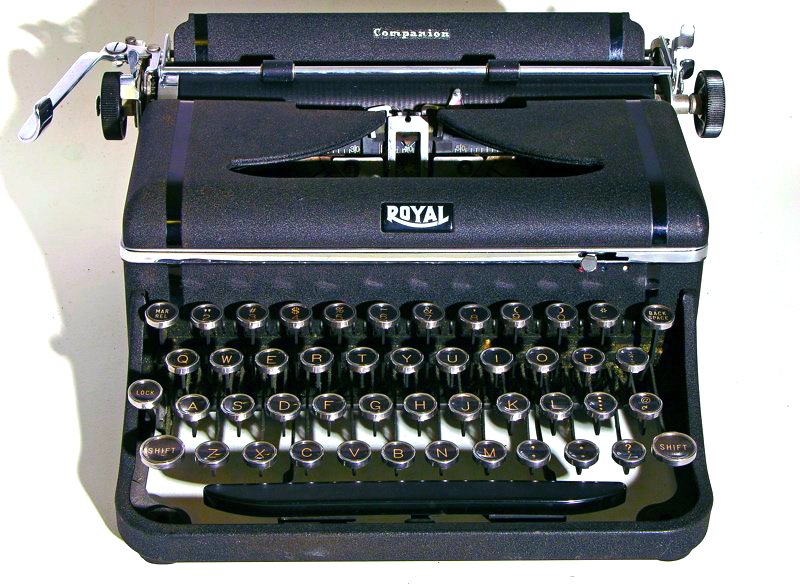
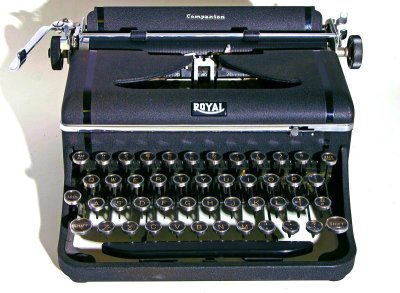
Royal
Companion
Serial # CD-163697
|
Royal Arrow
Serial # C-1127797R
1942
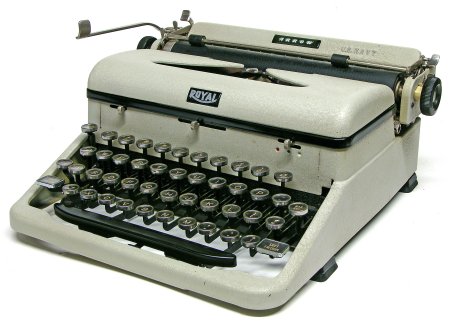
This version of the Arrow was made exclusively for the U.S. Navy during WWII. (Note the embossed and chromed "U.S. Navy" on the paper rest.) Specifically, it was what was known as a radio mill--a typewriter with a special, 9-pitch all-caps typeface and slashed zero that the ship's radio operator would use to transcribe incoming messages.
Download the manual for this typewriter here.
|
|
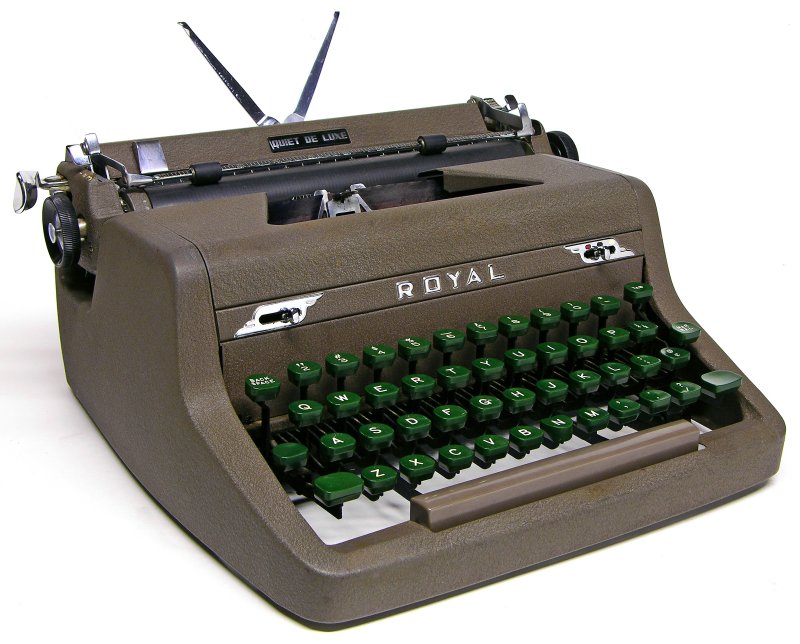
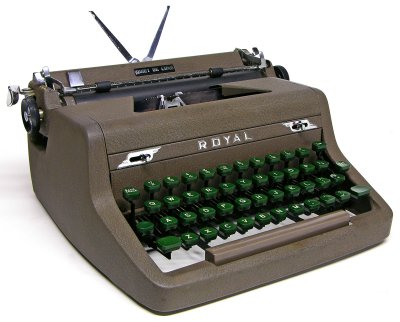
Royal Quiet DeLuxe
Serial # AG-2350325
1950
|
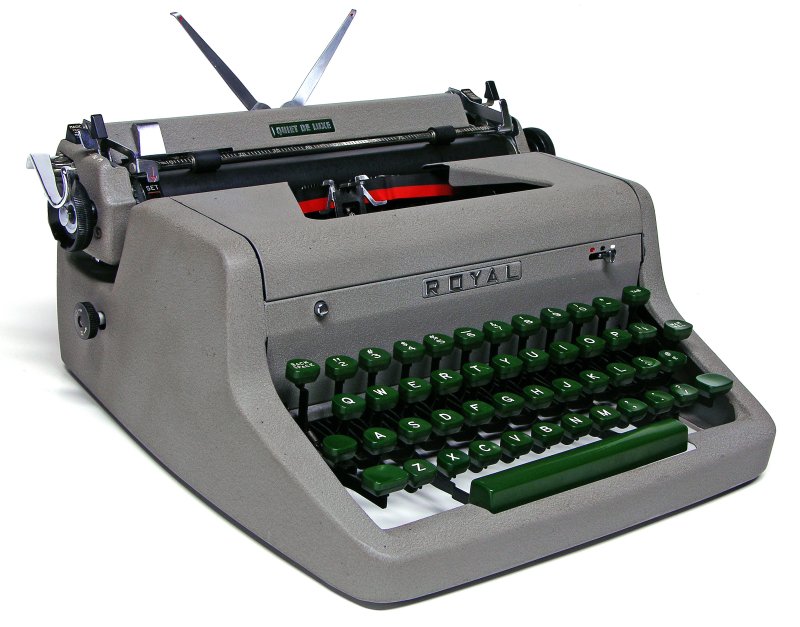
Royal
Quiet DeLuxe
Serial # RA-2672840
1953
Emeritus collection
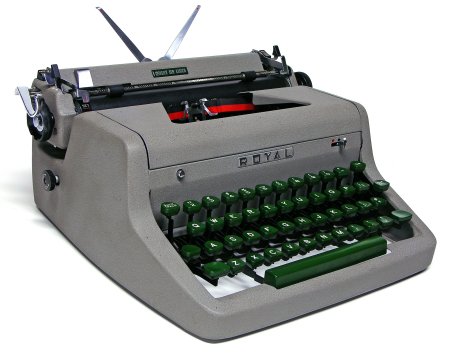
The updated Quiet DeLuxe added a push-button ribbon cover release, a carriage return tension adjustment knob beneath the left side of the carriage, a guide for determining how many inches of paper were left, and relocated the tab sets for easier access.
Download the manual for this typewriter here. |
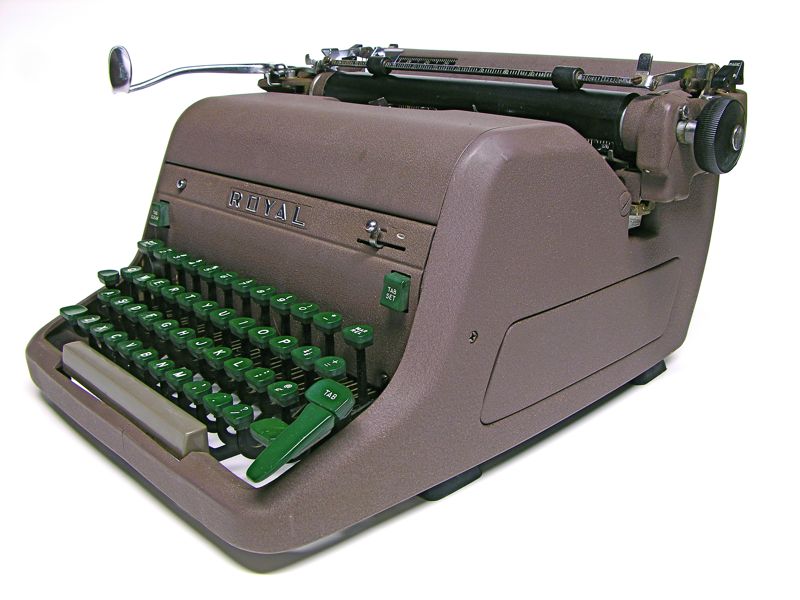
Royal
HH (x2)
Serial #s HHE-5259197 &
HHE-13-4912881 (13" carriage)
1954
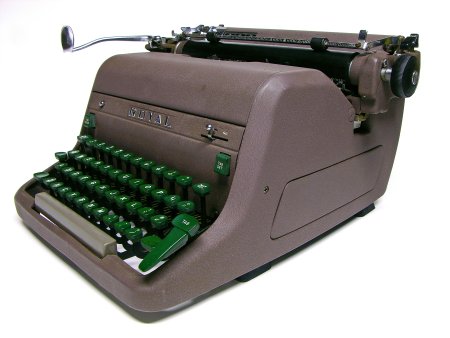
As an example of how well Royal built their typewriters, I found this covered with mildew and with its type basket, key levers, and inner workings inundated with dirt, leaves, bits of fur and feathers, dead insects, cobwebs, and even a couple of acorns. All I did was blow out the junk, brush it off and wipe it down, and it worked perfectly. Not a single drop of lubricant was needed.
The moral of this story is: just because a typewriter is dirty and stiff, that does not mean it is "dead". Many of my typewriters have come to me because someone thought that they were unusable, when in fact all they needed was a good cleaning or a minor adjustment or repair. Unlike today's products, typewriters were built to last. |
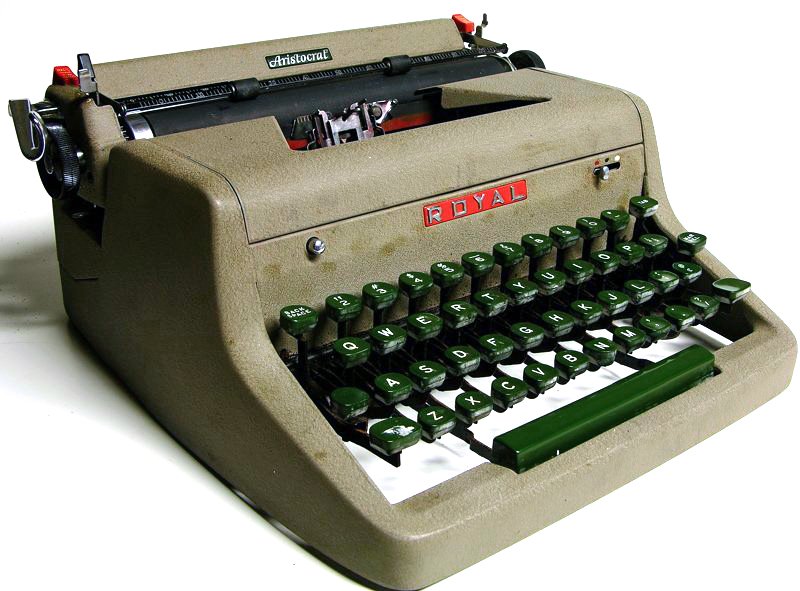
Royal
Aristrocrat
Serial # B3473176
1956
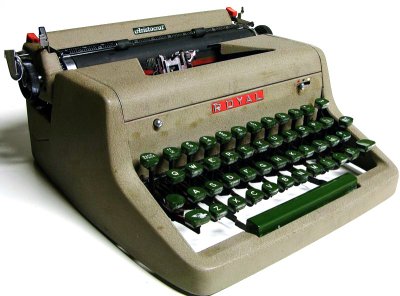
Download the manual for this typewriter here. |
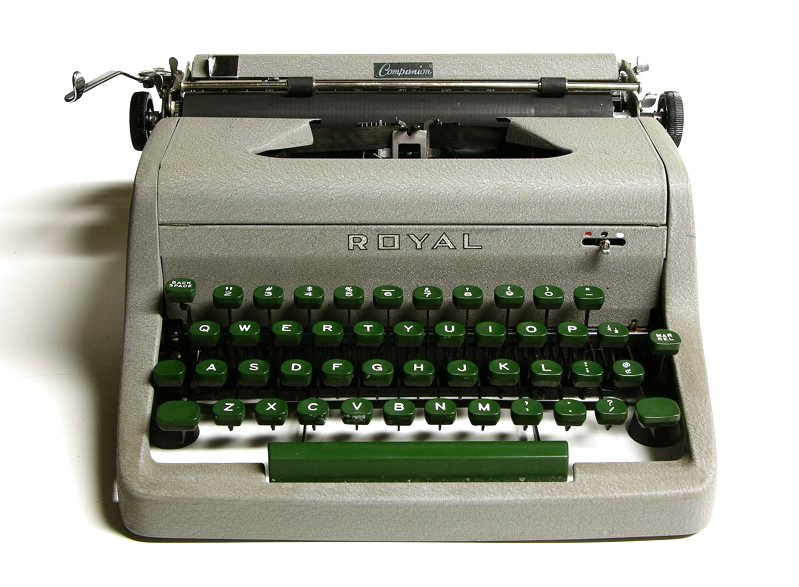
Royal
Companion
Serial # S3836301
c.1958
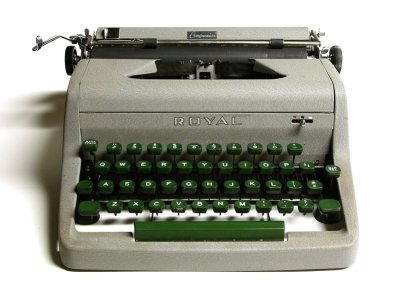
Download the manual for this typewriter here. |
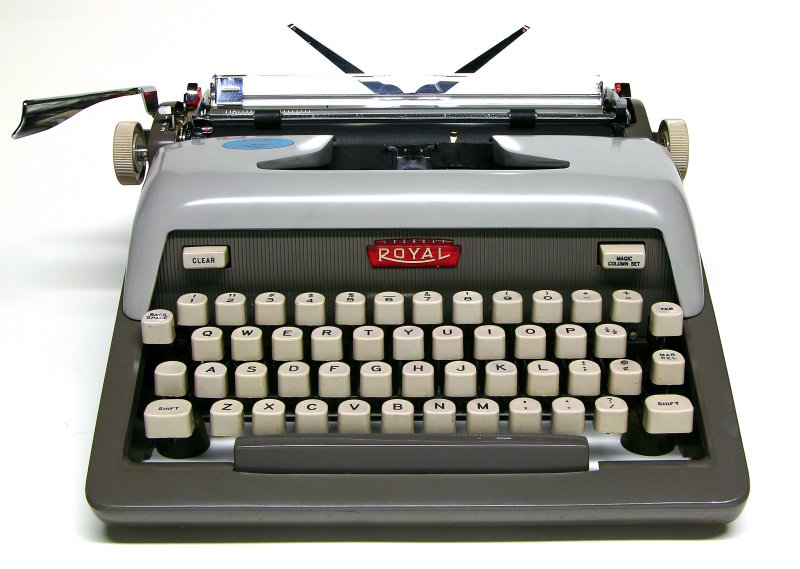
Royal
Futura 800
Serial # 2A4247769
c.1958
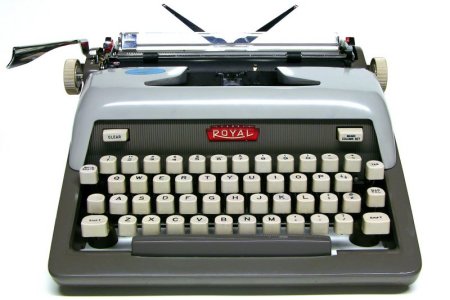
Note that the Royal logo acts as a hidden push-button release for the ribbon cover. |
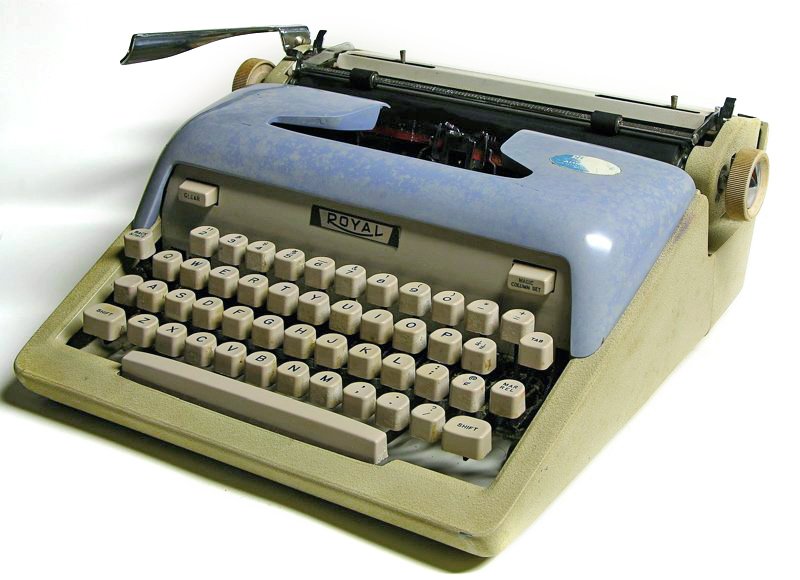
Unlabeled Futura body
Serial # m5200435
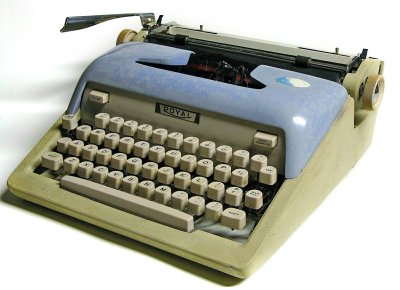
This curious machine is housed in a Futura-style body, but it is far from a Futura. The most obvious difference is that the famous Magic Margin feature is missing! The margins have to be manually set using the little sliders seen behind the platen. There is no paper guide or pop-up paper support. The Royal logo is silk-screened on and does not release the cover. Under the hood, it has no touch-control adjustment, and no carriage lock. This is truly a stripped-down Royal! I suspect that like the Heritage, this was an offshoot line sold through a catalog outlet. In fact, it shares many characteristics with the Heritage III, but it doesn't seem to be that, either. |
Royal FP, 1960. SN FPE-6978846
|
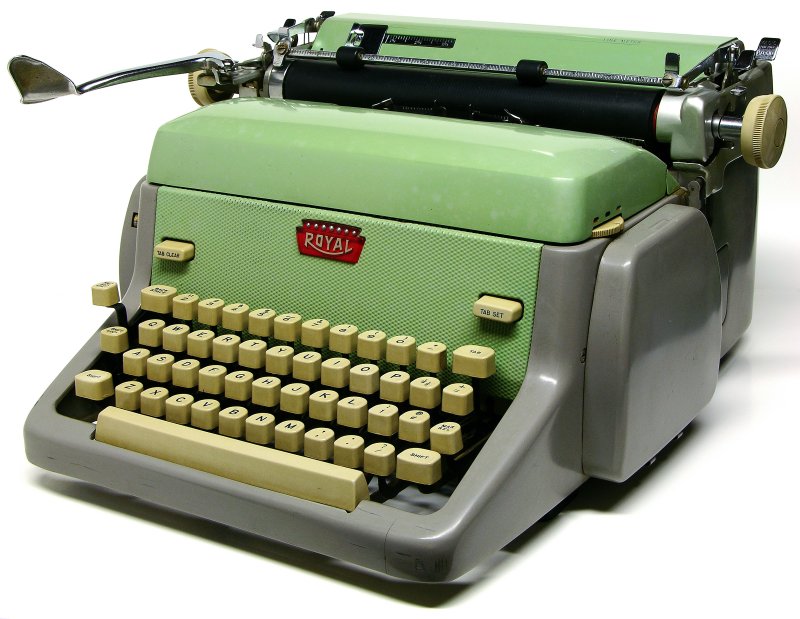
Royal FP
Serial #FPCS-7034720
1961
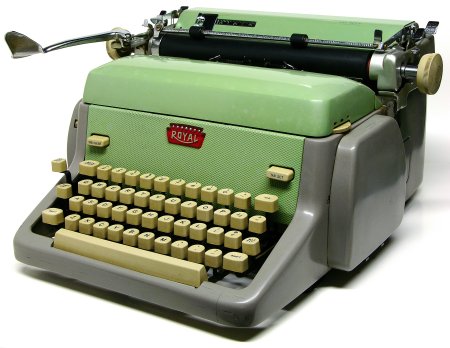
In the early '60s, Royal offered their standard typewriters in six different colors, so that office typewriters need not be "drab blobs". This minty-green FP with carbon ribbon is not only colorful, it's cursive!
|
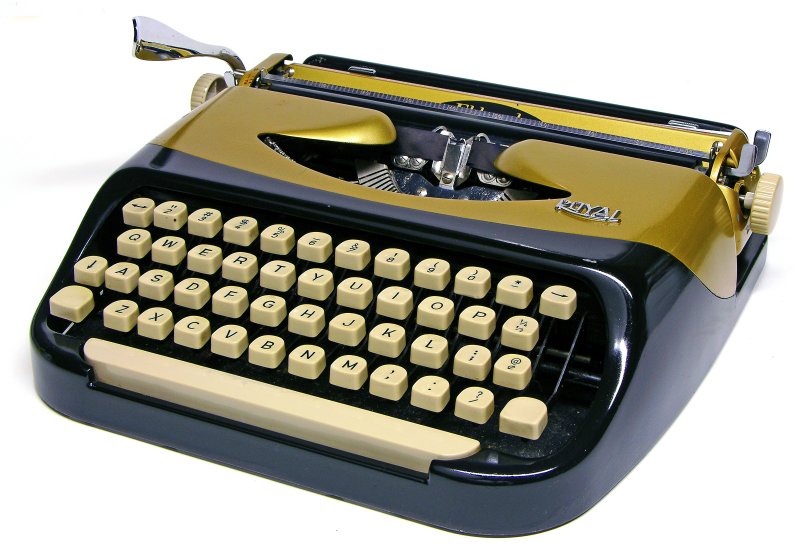
Royal Eldorado
Serial # E05121069
1962
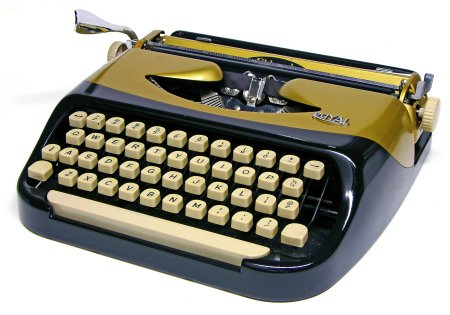
The Eldorado is essentially the Royalite in a black/gold color scheme.
|
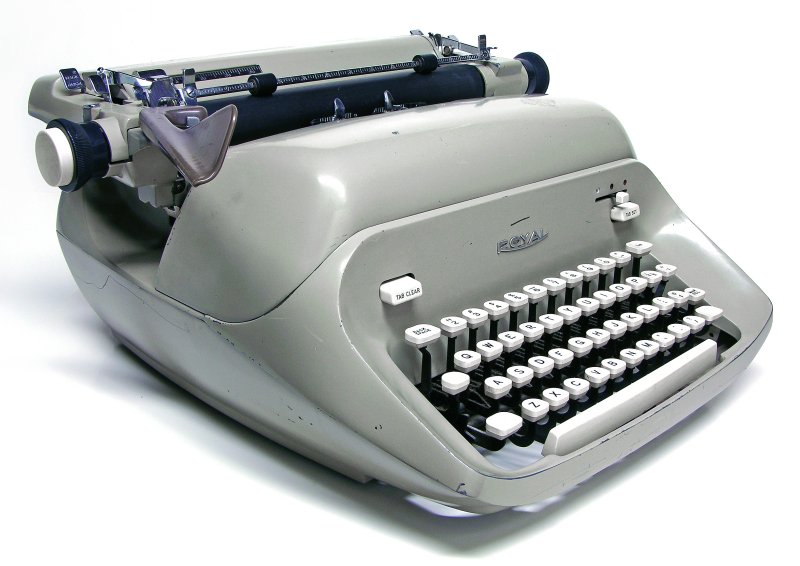
Royal Empress
Serial # MCE 11-8109527
1965
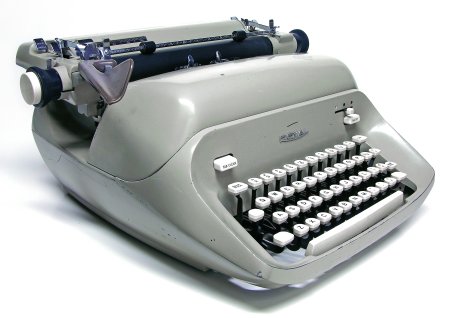
It's bigger than an IBM Selectric, and weighs almost as much, but it's
a manual! I like that it kind of looks like the Jetsons' car. Royal sold a similar-looking electric model called the Electress. It could be that the Empress was offered as a manual alternative.
Download the manual for this typewriter here. |
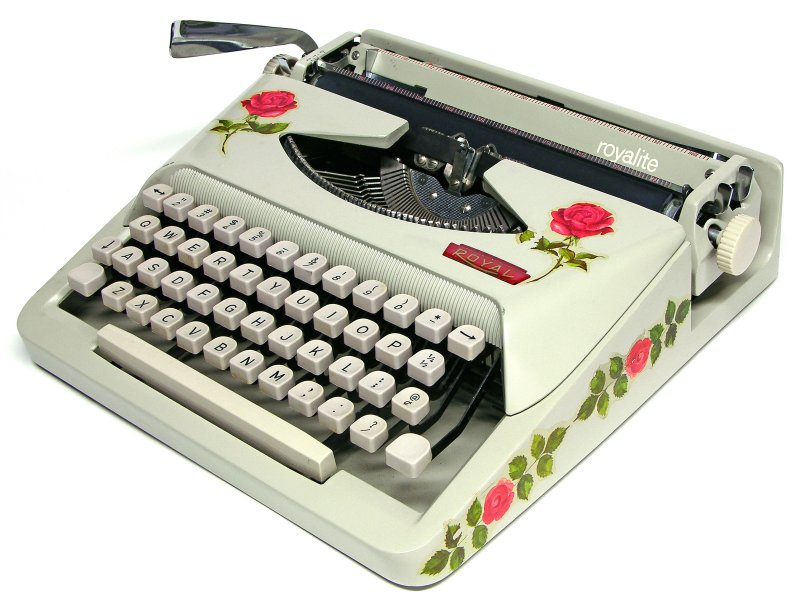
Royal Royalite
Serial # 6418099
1965
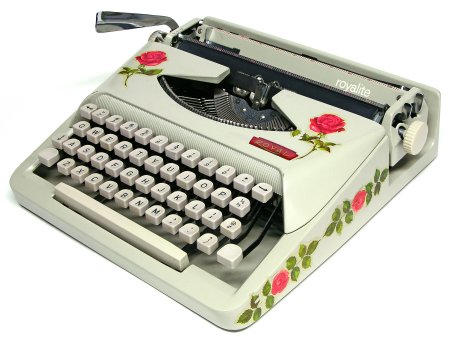
Yes, this Royalite was owned by a teenage girl (her class schedule was found inside the carrying case, along with 3 Gold Bond trading stamps).
Sometime in the early- to mid-'60s, Royal redesigned its compact portables from the style seen on the Eldorado above to the "squashed Futura" style seen here. Several other model names including Signet, Parade, and Arrow can be found in this shell, varying in their respective feature sets. This Royalite has no tab or color selector. |
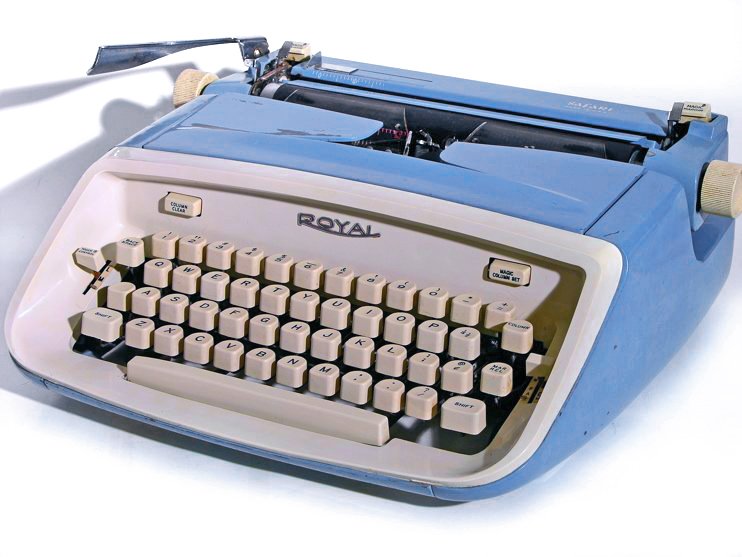
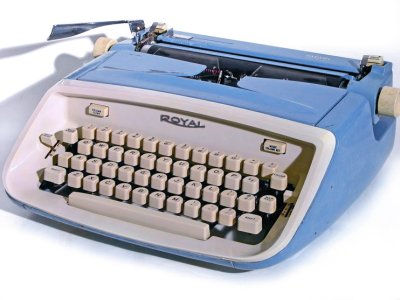
Royal
Safari
Serial # SA5390535
c.1965
|
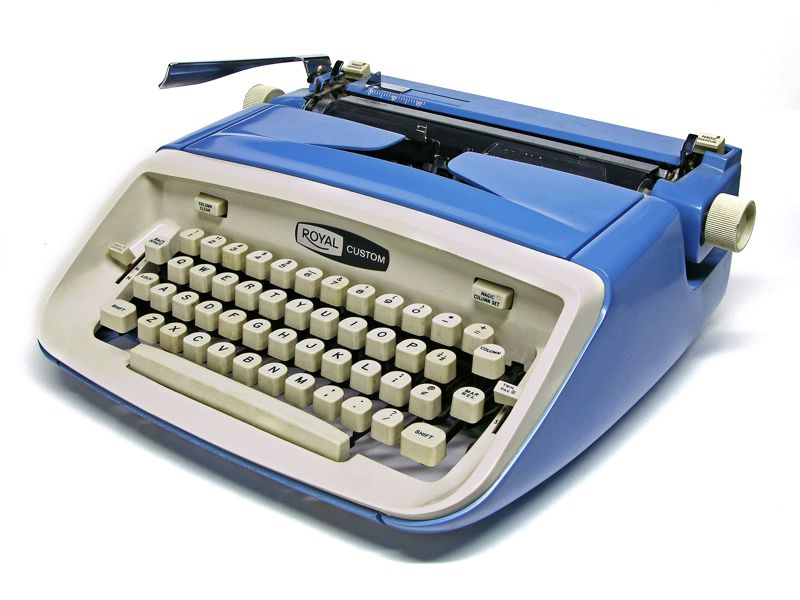
Royal Custom
Serial # CM6303616
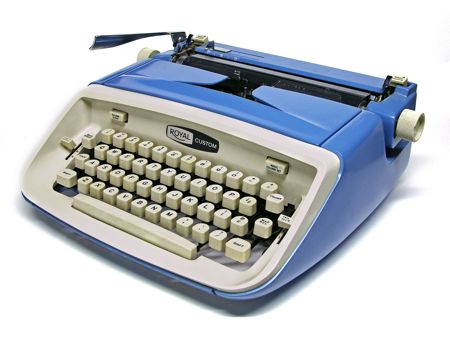
I'm hard-pressed to find any difference whatsoever between this Custom and the Safari pictured above. |
Royal Mercury
Serial # MC2876777
Emeritus collection
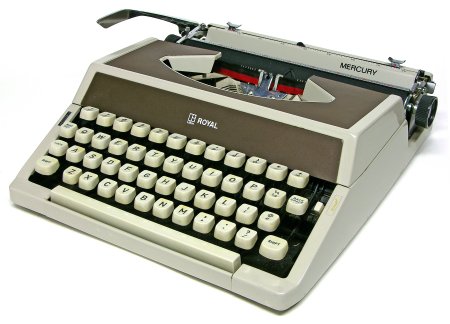
In the mid-'60s, Royal began to import rebranded Silver-Seiko machines from Japan. This Mercury is one example. Silver-Seiko bodies switched from all-metal to plastic in the very early 1970s, so it's a good guess that this dates from 1965-1971.
Download the manual for this typewriter here. |
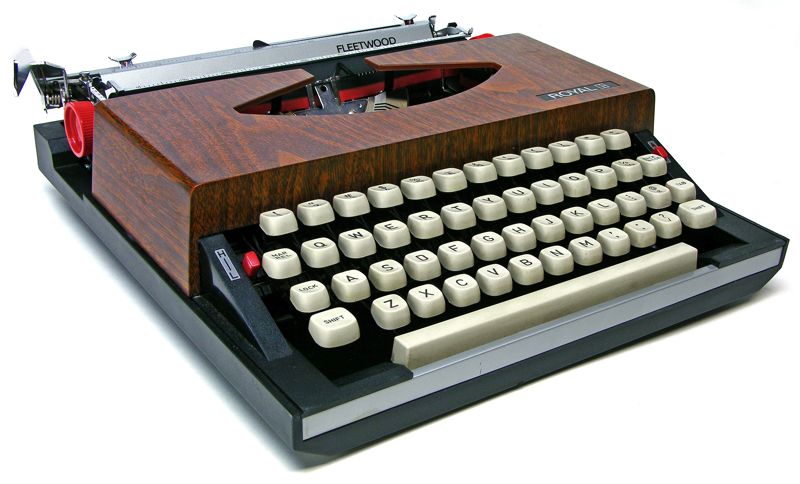
Royal Fleetwood
Serial # MR 8261299
c.1972
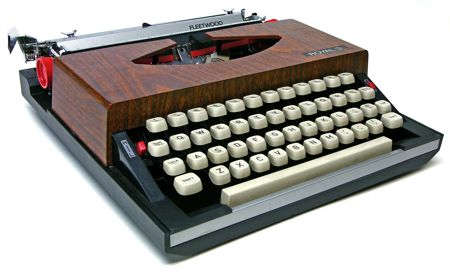
For better or worse, some things are an unmistakable reflection of their era. The Fleetwood, not content with just an accent of fake wood grain, had its entire upper half styled in fake wood grain. For good measure, its very square clamshell lid is, also. And because Danish Moderne lines and fake wood grain weren't hip enough, the lid had a transistor radio built into it, too.
Like the Mercury above, the Fleetwood was made in Japan by Silver-Seiko.
Download the manual for this typewriter here.
|
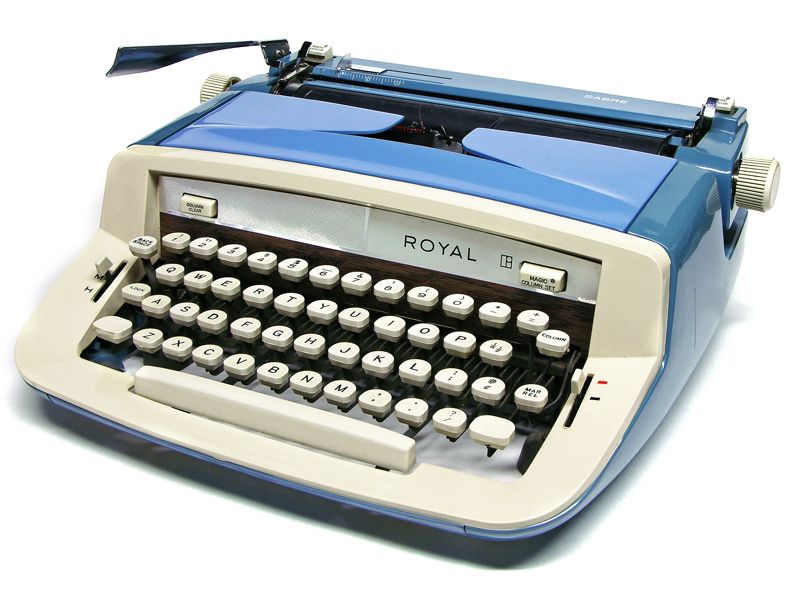
Royal
Sabre
Serial # SB 9028673 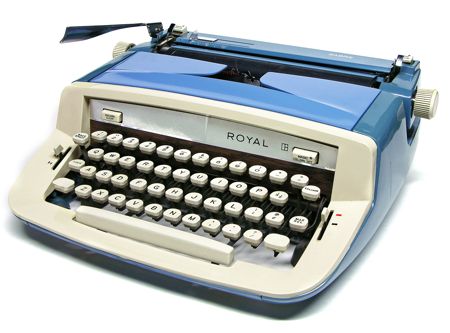
This Portuguese-made Sabre dates from the mid-1970s. Note the fake wood grain behind the top row of keys. |
|